Saturday, October 23, 2010

Book Design


One of my passions is book design. I'm not an expert, though. I appreciate books-as-art-objects, especially novels whose design and illustration enhance the story, where form and content mesh seamlessly.

David Diaz's design and illustration of my book The Wanderer (Joanna Cotler Books, HarperCollins, 2000, 305 pages) is (admitting bias) one of my favorites. (Examples above.)  Diaz designed a different icon for each of the 78 chapters, plus additional full-page sectional dividers. His artwork bears repeated close study for the way that repeated visual elements (swirls of the sea, for example) echo the story's repeated thematic elements. Some day I would like to frame each of his chapter openings!


The first chapter book in which I remember noticing the visual elements was The Timbertoes by Aldredge and McKee (Beckley-Cardy, 1932, 1943). It was also the first book I read in which I was completely and totally 'in the book.'  I remember staring at the illustrations that complemented the text, unable to leave the world of the story:


and

That color illustration still draws me in; the caption still makes me laugh.

David Diaz also "illuminated" my book, The Castle Corona (Joanna Cotler Books, HarperCollins, 2007, 320 pages.) I was stunned at the way his full-color illuminations perfectly captured the tone and milieu of the story. I may have slobbered over the artwork:


Each chapter opens with half-page full-color art.


The paper is rich, the edges are deckled. I love what Diaz and the publisher did with this book.

Three recent books I also greatly admire include:

Kate DiCamillo's The Miraculous Journey of Edward Tulane, with illustrations by Bagram Ibatoulline (Candlewick Press, 2006, 200 pages). I would have loved, as a child, to find this book in my hands. I would have pored over every sepia illustration and every full-color one:


and


Another recent book whose design I especially admire is Where the Mountain Meets the Moon, written and illustrated by Grace Lin (Little Brown, 2009, 282 pages).  The meshing of form and content is brilliant:


And a third, recent book with elegant design is Pam Munoz Ryan's The Dreamer, illustrated by Peter Sis (Scholastic Press, 2010, 372 pages). Everything about the design of this book–from the paper quality to the font style and size, to the illustrations, to the selection of green ink–embellishes the artistic awakening of the boy who is its subject.


Do you have favorites, especially among illustrated novels, to recommend?

I have more, so I'll need to revisit the topic later.  Meanwhile, please remember that all artwork above is copyrighted by the illustrators.

Ciao, bellas, and good night. . .

Tuesday, October 19, 2010

A Writer's Notebooks


Readers often ask if I keep a journal, and my answer is 'not exactly.'  Some writers use journaling to expand their thinking, to sketch and explore a character or a place or a plot in words.  Since I am working on a story nearly every day, that kind of exploration goes right into the rough draft, not into a journal.

What I keep are notebooks. The difference between these and journals are that most of my notebooks contain random fragments.  The notebooks on the above shelf, some of which go back twenty years, contain names and titles I might use one day; titles of books I wanted to read and books I liked; paragraphs from articles; cartoons; quotes--all sorts of random bits that felt worth noting.

What might seem odd is that I rarely open these once they are full.  They feel, instead, like 'insurance,' in case I ever run out of ideas!

I choose notebooks with nice paper, usually small:


The one ongoing 'big' notebook (like the 3-ring pink one above) is for the book in progress. I start a new one for each new book; it holds lists of characters, chapter summaries, ongoing questions to myself ("What does this MEAN??"), title possibilities, etc.  A few photos are tucked into that binder; these are from a place that appears in the story.

In the 'current' smaller notebooks go stray words, phrases, and titles that don't fit the current book but are probably zinging around for the next one.  Also in the current books are bits from dreams, random doodles, cartoons, travel notes.


I might save a favorite cartoon (usually by Harry Bliss) or a note about a camera someone has mentioned:


The drawings usually emerge when I'm on the phone but my mind is still 'in the book,' so maybe I am doodling a scene from it, or just letting colors realign my thoughts:


On the right-hand page above, I was in Switzerland, looking out the window, thinking of the angel in The Unfinished Angel, and what that angel might see from her/his tower. I am not an illustrator, obviously; I am a doodler.

If you were to trawl through all my notebooks, I think you would be puzzled. You might wonder how all those random thoughts and drawings could possibly represent the mind of a writer.  But here is how I think of them:  they show some of the flotsam that floats in and out of my head, but the books I write are my attempt to shape something meaningful from all of that 'stuff.'

Do you keep a notebook? A journal?

Tuesday, October 12, 2010

Drafts, Lake and Trees


In the third draft of the book in progress, I ruthlessly cut a hundred pages and made the pages messy but the story neater. Yesterday I printed out a clean fourth draft: so nice to have clean margins and pristine pages.  Now I'm going through this draft slowly, seeing if is whole yet.

Meanwhile, the outside is calling, calling:

Gorgeous out there!  So I work for two hours and then go outside for a bit.


The dock is out, but the kayak is merely resting, waiting for me.

Back inside, I work for another couple hours and then dare to look out the window:


Guess I'd better get back out there. Maybe those trees and leaves and lake will make their way into the story. Maybe the Deep Significance of the story will come to me as I'm paddling the kayak. Or maybe not.


Friday, October 8, 2010

Rocks


Last week I wrote about an accumulation of boxes. This week I noticed another clump of objects that have found their home in our home:  rocks.  I love rocks--their solidity, their texture, their permanence. I love to sit on them, walk on them, hold them.  Usually, I like rocks in their natural habitat–outdoors–but a few special ones take pride of place on my desk or night stand.

The large one above at top left was a present from my daughter when she was four; the rock is from northern Virginia.  At top right is a flattish rock with great bumps and mottling, from Lake Chautauqua in western New York.  Bottom left is a special hunk from southern Switzerland, and the one at bottom right, a gift, is from the coast of southern England.


The above two rocks are particularly special. They're from Maine, gifts from my grandchildren.

I use each of the rocks as paperweights or simply as reminders of all that is simple and perfect. I cannot tell you what kind of rocks they are; I'm no specialist.  Perhaps you will know. . .

Saturday, September 25, 2010

Boxes, Part II


The pink gift box with woven top is one of my favorites. I've forgotten what the gift was inside (candles perhaps), but I know who it was from and think of her whenever I see this box (every day). Next to it is a wooden puzzle box from North Carolina that my husband gave me for Christmas one year.


A gathering of little red gift boxes, all of them empty now except for the back center cloth-covered Japanese one, which has a perfume bottle inside. That one is also the largest at 3 in. x 2 in.; the smallest is about 1-1/2 inches square.


The above box was a gift from a Korean student. It is wood with fabric on the front of the small drawers,  stands almost 6 inches high and is 4 inches wide. I use it to hold earrings--simple ones, no diamonds, alas. It really needs to be seen in person to be fully appreciated.


Above are two empty boxes. The top is cloth-covered and came with a necklace inside, and below that  is a Florentine box, from Italy--in this case, the box was the gift. I used to keep letters in it.


Above are two Swiss music boxes, gifts from my husband when we lived in Switzerland (the front one from 1982 and the back one from 2007.)  They are small, about 6 in. x 4 in. and hold a few novelty trinkets. The green one plays "Nach em Rage schint Sunne"; the black one plays Rapsodie Sur Un Theme De Paganini.


This last box is perhaps my favorite of all, another gift from my husband, from Windsor, England, around 1984.  He found it at one of our favorite shops: one devoted almost entirely to old boxes.  It is 8 in. x 12 in. and holds photographs.

There are more boxes scattered throughout our house; I'll round them up some day soon.

The Lure of Boxes


I seem to have accumulated an assortment of boxes. Most have been given to me; some I've chosen. I'm drawn to them. Like books, they suggest treasures within. You might find anything at all.  Mine don't hold treasures, though--or at least not ones valuable to anyone but me; often it is the box itself that is the treasure.

The above three boxes were all gifts. The cloth-covered one on the bottom, with the moons, was from my daughter when Walk Two Moons received the Newbery Medal.  The middle wooden box with decorative inlays was, I think, once my husband's and it once held chess pieces, but the pieces are now gone and the box now belongs in my office and holds pens.  The top box is velvet with a silver top and was a gift from the founder of the European schools in which we worked for twenty years. 


I love the above three manuscript boxes (wood with Liberty paper overlay); they've been in constant use since my husband bought them in London and gave them to me in 1990. The small pencil box on top is from Florence, Italy, and holds . . .pencils.

Friday, September 17, 2010

Fan Mail


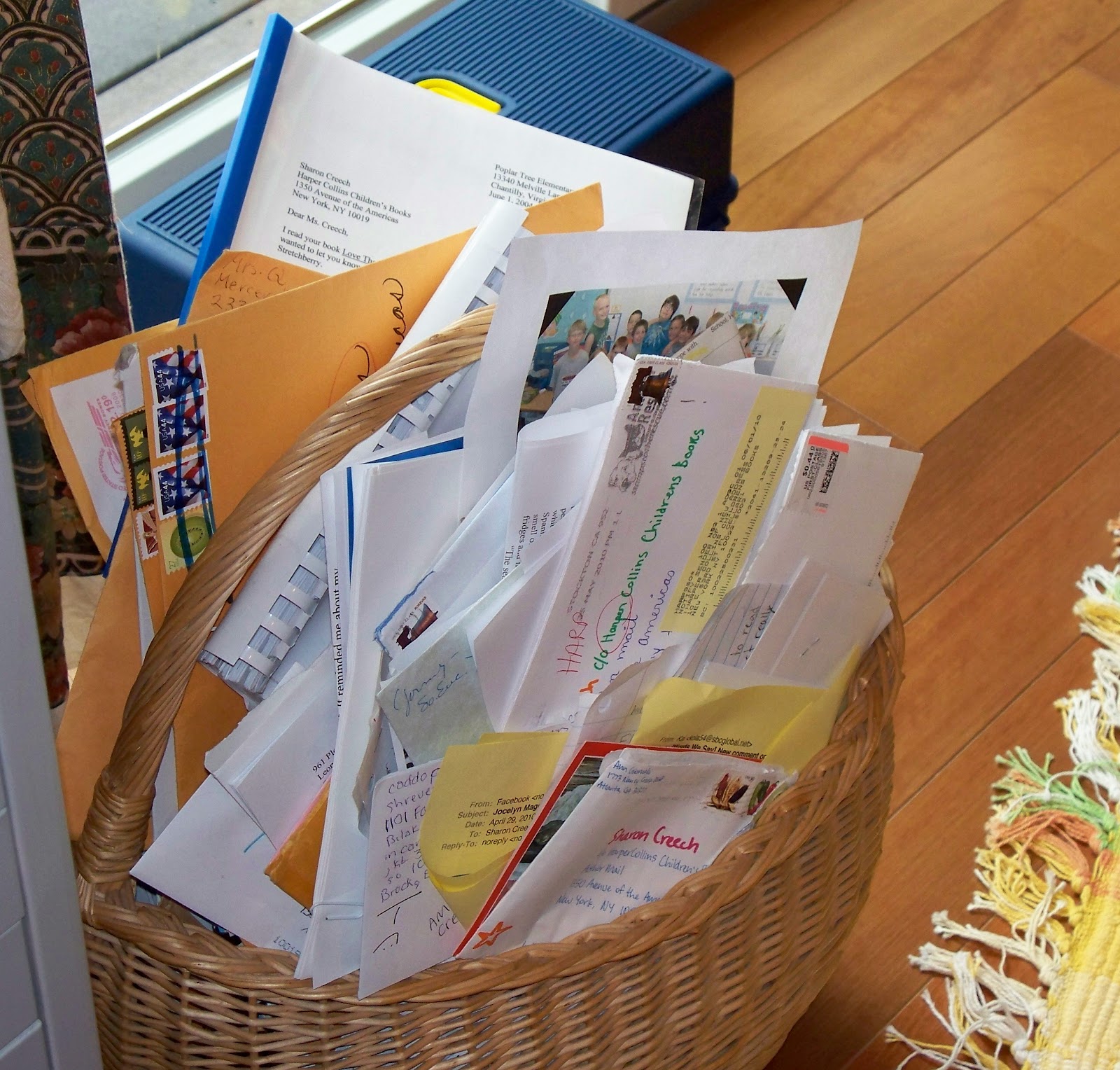
Fan mail, ah fan mail, both a joy and a challenge: It's usually a joy to read and always a challenge to keep up with responding. I especially love coming across beautifully crafted letters, and I am partial to student drawings.  In the above basket, I save 'special' letters. These are ones that are particularly moving or funny or beautifully made.

In a recent batch, I enjoyed these colorful letters from a school in Texas, based on Love That Dog and Hate That Cat and inspired by their creative teacher:


And these from a school in Pennsylvania, using concrete poem-drawings and also inspired by another creative teacher:


And these, from a school in Ohio: woodcuts that blew me away with their beauty. The third grade students had read The Wanderer and then made woodcuts in the style of those by David Diaz that decorate chapter headings in the book. The woodcuts were presented on beautiful parchment paper, with the students' own handwritten words below.  Third grade! What a great teacher they have.